

What Barna’s latest research reveals about families, faith and the future of ministry
Every time I visit one of BDI’s Rescue Mission partners, I’m encouraged by their relentless focus and unwavering commitment to care for people. These ministry leaders especially understand what it means to serve individuals, families and communities being shaped by shifting cultural and spiritual trends.
Our nonprofit partners feel acutely how changes in family structure, faith engagement and emotional well-being influence not only the people they serve, but also their staff and donors.
That’s why BDI pays close attention to research like Barna Group’s. While these insights aren’t fundraising strategies, they provide mission-critical context for the long-term sustainability of our partners’ ministries.
As the Great Wealth Transfer accelerates – bringing younger generations into the fold of charitable givers – understanding how faith and family trends are evolving is key for ministries seeking to engage and empower these emerging donors.
The two Barna articles that follow provide insights into family and faith trends that are shaping Christian ministry into 2026. I encourage you to consider how these realities are being felt at your organization – from the guests you serve, to the staff you rely on, to the donors you engage.
This is the kind of research that helps nonprofit leaders see around corners… and prepare with confidence for what’s next.
2025 Year-End Insights: 4 Trends on Today’s Family
Read the original article here.
From shifting marriage patterns to rising mental health concerns, 2025 offered a revealing look at the shifting realities of marriage, parenting, relationships and family well-being. Together, these findings paint a more complete picture of how Americans are engaging in family life.
Here are four family trends we researched in 2025.
1. Marriage Is Changing, But Commitment Still Matters
Barna’s marriage and divorce trends analysis revealed a landscape in transition. While fewer adults are choosing marriage today, the institution still holds deep significance.
- Barna data show that just under half of U.S. adults today are married (46%), compared to two-thirds in 1950, according to U.S. Census data.
- Pastors far surpass the national average: 91 percent are currently married, and 97 percent have been married at some point.
- In total, nearly one in five U.S. adults (18%) says they’ve experienced divorce.
Pastors are just as likely to have been divorced (18%), yet are much more likely to remarry—73 percent of divorced pastors remarry, compared to just 55 percent of all U.S. adults. Only 4 percent of pastors are currently divorced.
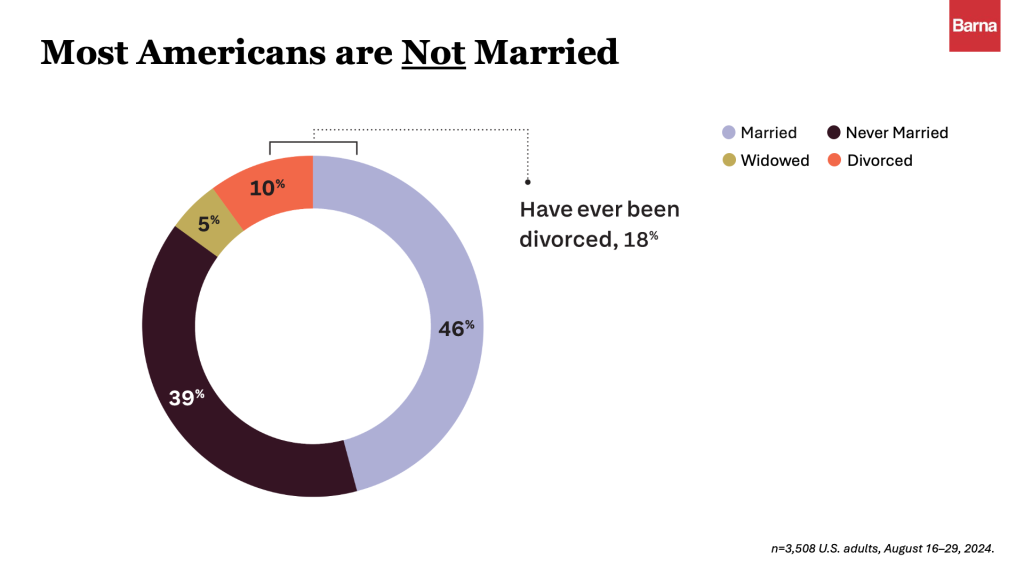
Younger adults continue to delay marriage or favor long-term partnerships without formal vows. Yet across demographic groups, married adults consistently report stronger relational satisfaction and emotional stability than their single peers. And while plenty of couples are navigating pressure points—from finances to communication—most say they still view marriage as a lifelong commitment worth preserving.
For ministry leaders, marriage foundations and support remain essential discipleship needs, especially among young adults discerning long-term relationships.
2. Families Are Feeling the Strain—and Many Aren’t Sure Their Church Sees Them
In our study, The State of Today’s Family, church leaders overwhelmingly reported that family life within their congregations has become more complex—not less. The “nuclear family” is no longer the dominant household type for Americans. Singles, blended families, single-parent households, multigenerational homes and nontraditional structures make up a significant share of church bodies.
Yet churchgoers are split on whether their pastor understands these realities. Fifty percent of Christians or churchgoers tell Barna, yes, “Our pastor is understanding of the experiences of blended families and nontraditional family structures.” But the other half says this is not the case (27%) or that they are not sure (23%).
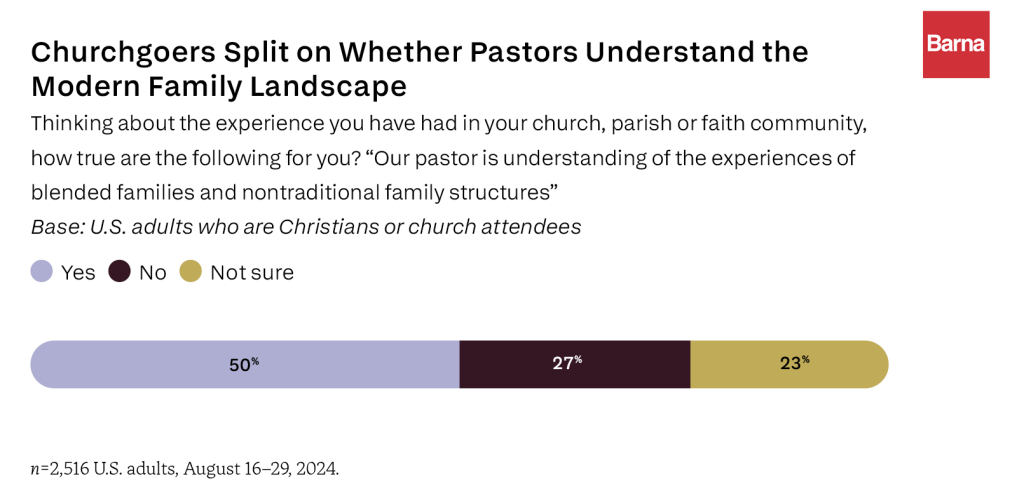
This divide may stem from the fact that pastors themselves largely represent traditional family structures: 91 percent are married, and 90 percent have children. These experiences provide natural strengths for discipling spouses and parents—but they can unintentionally create a ministry ecosystem geared primarily toward nuclear households.
Service schedules, group structures, messaging and budgeting priorities often reflect that default. The challenge for churches in 2026 will be balancing strong marriage and parenting ministries with an equally clear and compassionate path for individuals and families who don’t fit the traditional mold.
3. Parents Are Deeply Concerned About Their Teens’ Mental Health
One of the most resonant stories of the year came from our study on parenting and teen mental health. The research confirmed what many parents already sense: today’s young people are carrying heavy emotional burdens.
Parents ranked anxiety, depression and loneliness among their top concerns for their teens. Many feel unsure of how to help—and are especially uncertain about when to step in with professional support.
But the study also highlighted a hopeful reality: a warm, steady parent-child relationship is one of the strongest buffers against mental health struggles.
Parents who regularly…
- Check in emotionally
- Create space for meaningful conversations
- Set healthy boundaries
- Model coping skills and faith practices
… are more likely to see their teens thrive.
Churches can play a pivotal role here too, helping parents build resilience skills, fostering intergenerational relationships and normalizing mental health conversations within faith communities.
4. Pastors Who Are Parents Carry Hidden Pressures
This fall, Barna released new research on the parenting pressures pastors feel, and the findings were striking. Pastors who are raising children often experience the same challenges as other parents—but intensified by the visibility and expectations of their role.
Many pastor-parents reported feeling:
- Worried about their kids growing up under a microscope
- Guilty about time spent away from family due to ministry demands
- Unsure how much of their children’s struggles to share with the congregation
- Concerned about burnout—for themselves and their families
Despite these realities, pastor-parents often hesitate to seek help, feeling they must model strength or resolve challenges privately. This research underscores a critical need: churches must care not only for the pastor but also for the pastor’s family, ensuring leaders have the relational, emotional, and structural support necessary for long-term well-being.
Taken together, these family-focused insights reveal the relational pressures shaping everyday ministry – from parenting and mental health challenges to the hidden burdens carried by ministry leaders and their families.
But these faith and family trends are only part of the story. To understand where spiritual engagement is heading, we also need to look at how beliefs and faith participation are changing across generations. That’s where the next set of Barna findings comes into focus…
Barna’s Top Trends of 2025, Part 2
1. Pastoral Flourishing: What Helps Leaders Thrive
Church leaders are asking harder questions about sustainability.
Building on conversations around burnout, this article reframed the discussion toward flourishing—looking at the conditions that help pastors remain spiritually grounded, emotionally healthy and vocationally resilient. Readers responded to a more holistic and hopeful vision for pastoral life—one that looks beyond endurance to long-term sustainability.
Key data point:
Pastors who report strong relational support, clarity of role and alignment with their church’s mission are significantly more likely to describe themselves as thriving—not just surviving.
2. Fostering Relationships at Church Still Matters—Deeply
Belonging remains a central driver of faith connection.
As churches navigate digital tools, hybrid gatherings and changing attendance patterns, this article reaffirms a core truth: relationships remain one of the strongest predictors of long-term church engagement.
Key data point:
When Barna asked U.S. adult churchgoers who they talk to before, during or after church, at least half say they engage with a pastor (57%), other attendees (53%) or church staff (50%). These everyday interactions represent meaningful entry points for deeper discipleship—opportunities leaders can intentionally strengthen.
3. Women and Men Experience Church Attendance Differently
Gender gaps are shaping the future of congregations.
This article examines how men and women relate differently to church participation, leadership and belonging. Together, these differences suggest churches may need more tailored approaches to engagement rather than assuming uniform experiences across genders.
Key data point:
In the early 2000s, women were more regular attenders than men by a wide margin. Over the years, however, churches have been losing women more than they are gaining men, with the exception of 2025 when male attendance spiked upward.
As of 2025, 43 percent of men and 36 percent of women report attending church regularly, based on reported weekly attendance. In five of the last six years, men have outpaced women in this key measure of religious engagement, and the 2025 gap is the largest measured.
4. Young Adults Are Leading a Resurgence in Church Attendance
A surprising shift is challenging long-held assumptions about younger generations and churchgoing.
This article pointed to an unexpected and compelling finding: recent increases in church attendance are being driven largely by young adults. After years of decline, Barna’s data reveals a reversal that complicates familiar narratives about disengagement among Millennials and Gen Z, and invites closer examination of what’s drawing younger adults back into congregational life.
Rather than signaling a simple return to “business as usual,” the findings suggest a more nuanced reengagement, shaped by questions of belonging, meaning and spiritual exploration.
Key data point:
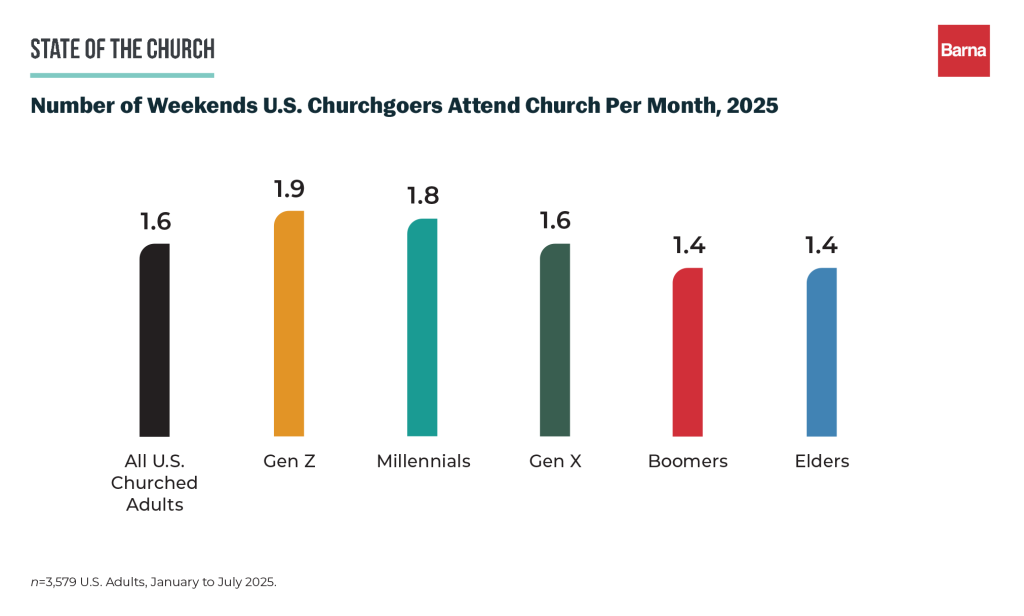
Millennial and Gen Z Christians are attending church more frequently than before—and more often than older generations. The typical Gen Z churchgoer now attends 1.9 weekends per month, while Millennial churchgoers average 1.8 times, representing the highest attendance levels among young Christians since Barna began tracking them.
5. Belief in Jesus Is Rising—Especially Among Younger Adults
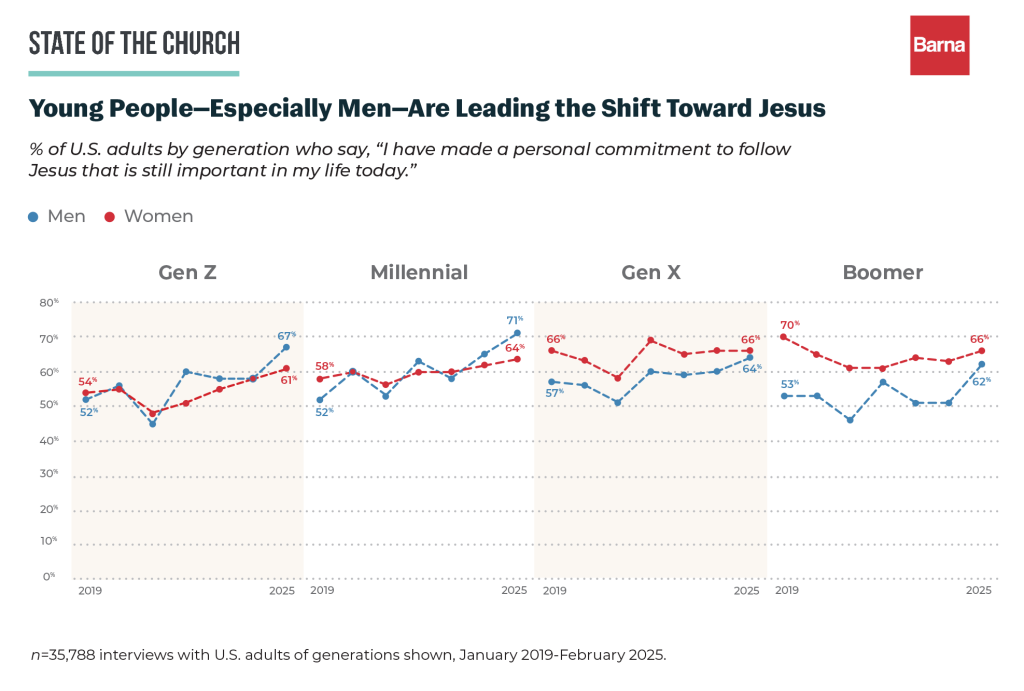
The most-read Barna article of 2025 captured widespread attention in mainstream and religious media outlets by documenting an unexpected development: belief in Jesus is rising. This rise signals renewed openness to the person of Jesus—particularly among Gen Z men.
Key data point:
According to Barna’s latest data, 66 percent of all U.S. adults say they have made a personal commitment to Jesus that is still important in their life today. That marks a 12-percentage-point increase since 2021, when commitment levels reached their lowest in more than three decades of Barna tracking. This shift is not only statistically significant—it may be the clearest indication of meaningful spiritual renewal in the United States.
What These Stories Signal for the Church
Viewed together, these stories highlight a season of tension and transition for the Church: families shaped by long-term relational change and many believers practicing faith more privately than communally. At the same time, the data points to real openings—teen curiosity about Jesus, enduring hope for marriage and a growing recognition that spiritual formation deepens in relationship with others.
Stay updated on what’s next for nonprofit fundraising!
Sign up for our newsletter today to get the fuel that will help boost your fundraising for nonprofits to the next level.