

New research busts the biggest myths about donor email fatigue – and points to what’s really costing Rescue Missions engagement
From Alicia Fletcher, Senior Email and Lifecycle Manager
Every Rescue Mission development director has heard this at some point:
“You send me way too many emails.”
“I delete all of my emails without reading.”
For years, nonprofits have made strategy decisions based on complaints like these. Cut the file back. Reduce the sends. Pull the plug on a series that was working, because donors are complaining.
New research suggests most of those complaints do not parallel the behavior of the donor.
BDI’s partners at Grey Matter Research and Infinity Concepts recently released You’ve Got Mail: Evangelicals and Donor Email, a study of 1,000+ Christian donors fielded in mid-2025. This robust study challenges assumptions that shape donor email strategy across almost every type of nonprofit. Today, I am excited to share the key findings!
Myth 1: Donors Are Flooded With Nonprofit Email
The data says otherwise.
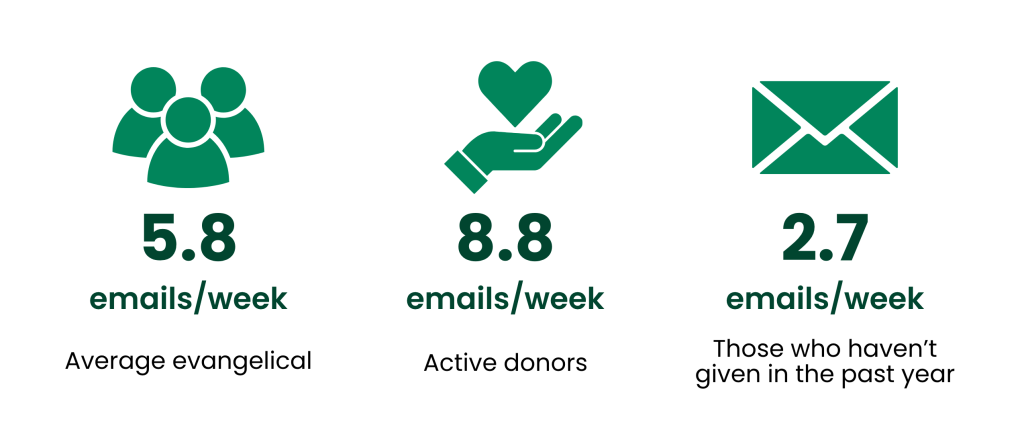
Evangelicals report receiving an average of 5.8 emails from charities or ministries in a typical week. That figure covers all evangelical Protestants, donors and non-donors alike. Among active donors, the average amount of emails received rises to 8.8 per week. Among those who have not given in the last 12 months, it is 2.7. Even at 8.8 emails per week, this is slightly more than one email per day from every nonprofit a donor supports or has ever been prospected by.
The perception of being flooded with email is legitimate, but it’s concentrated in a small slice of the population: only 3% of evangelicals recieve 50 or more nonpofit emails per week. For the overwhelming majority, “flooded” isn’t the lived experience.
It’s important to keep in mind that when a donor calls to say they are drowning in emails, that experience is not reflective of the feeling from your entire donor file. In these circumstances, it’s important not to change your email strategy based on a few loud donors. Instead, address unhappy donors individually, with their specific giving patterns in mind.
Myth 2: Donors Block Or Unsubscribe As Soon As They Get Annoyed
Also not true, at least at the scale most of us assume. Most donors tolerate far more email than fundraising teams tend to assume, and the fear of triggering mass unsubscribes by staying in touch is, more most programs, overstated.
Seventy-three percent of evangelicals say they do not block, unsubscribe from, or send to spam any of the emails they receive from organizations they have supported. Only 7% block all of them.
For prospecting emails, from organizations they have never supported, 67% still take no avoidance action at all. Among donors who do get email, 84% receive it in their regular inbox instead of a secondary address or a spam folder.
When roughly three out of four donors never take any avoidance action, a stable unsubscribe rate can tell you very little about whether your program is actually working on it’s own. Because of this, it’s important to build reporting that looks holistically at several email metrics including bounce rates, engagement rates, conversion rates, and more.
Myth 3: Nobody Actually Reads Your Emails
Good news! According to the study, when evangelical donors receive email from organizations they support:
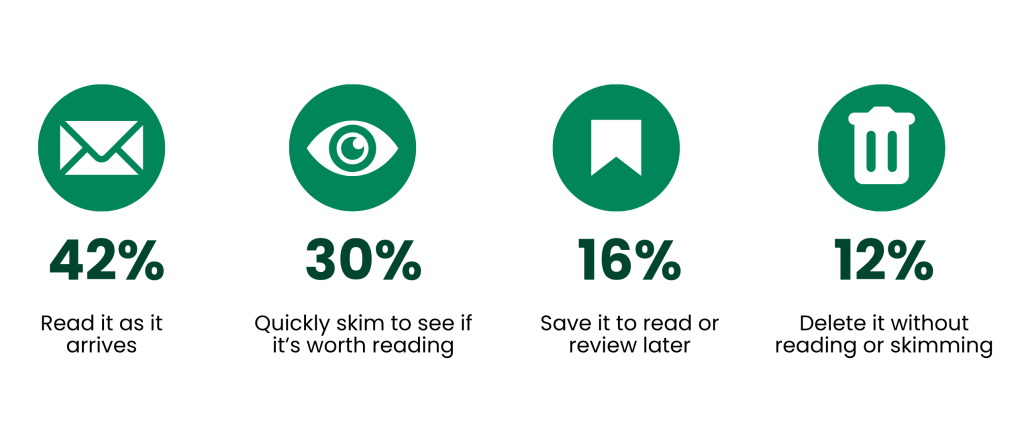
- 42% read it as it arrives
- 30% quickly skim it to see if anything is worth reading
- 16% save it to read or review later
- 12% typically delete it without reading or skimming
In these findings I want to call out what that 30% are doing. They are skimming specifically to decide whether anything is worth reading. That is a verdict rendered in about three seconds, on your subject line and preheader, headline, and main CTA.
It’s important to lead your donor communications with substance, taking time to develop headlines that carry meaning on their own, and putting the most important messages near the top, above the scroll.
The Problem Isn’t Frequency, It’s Relevancy
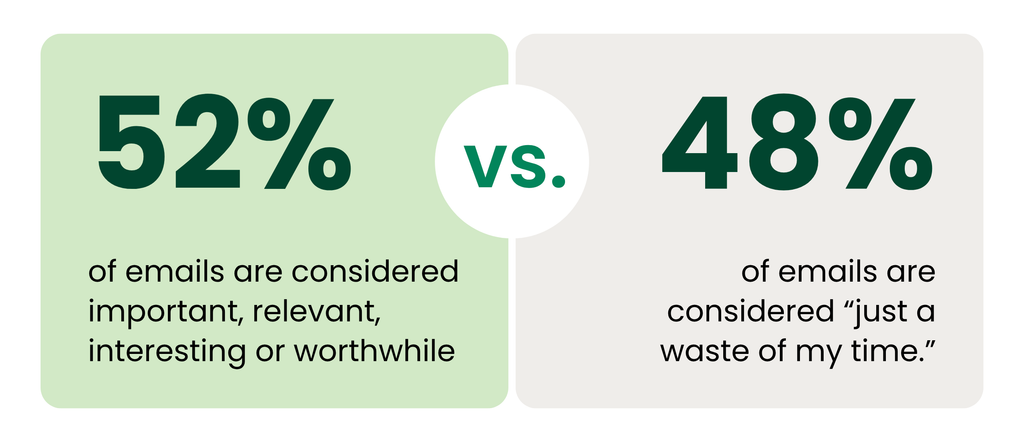
Donors say 52% of the emails they receive from organizations they support are “important, relevant, interesting, or otherwise worthwhile.”
That leaves 48% described as “just a waste of my time.”
Eighty-three percent of evangelicals say at least some of the email they get is a waste of their time. Eight percent say all of it is.
That means that your donors are opening your email. They are giving you their attention.
When donors do take steps to avoid nonprofit email, the reasons they give are worth studying:
- 48% never signed up for the emails
- 43% were not familiar with the organization
- 35% received too many emails from that organization
- 34% said too many of the emails were requesting money
- 30% found the content uninteresting or irrelevant
- 20% said the emails were too long
Grouped together, 70% of those who avoid email cite something about the emails themselves. Sixty-five percent cite unfamiliarity. Forty-three percent cite disinterest in the cause or the organization.
Almost every item on that list is a decision your Rescue Mission makes; not a limitation of the channel.
Email can do considerably more than ask for money. The report names several alternatives worth building into your calendar: expressing thanks, connecting your mission to local or national events, sharing a prayer request, asking donors how your staff can pray for them, demonstrating the impact a gift produced, and informing donors of a developing need before you ask them to meet it. Each of those messages can still carry a giving opportunity. It’s proven to be more powerful to have your ask travel alongside genuine communication rather than being the entire reason the email exists.
Good News: Your Largest Donors Are Your Most Attentive Readers
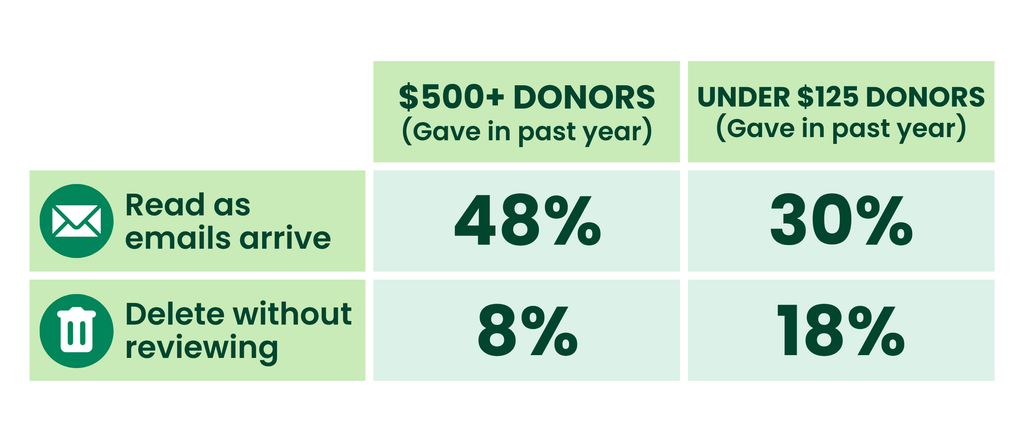
Contrary to the assumption that larger donors are too busy or too solicited to engage, donors who gave $500 or more in the past year are the most likely to read retention emails as they arrive (48%), and the least likely to delete without reviewing (8%).
Donors who gave under $125 are the least likely to read as received (30%) and the most likely to delete without reviewing (18%).
This means that your most attentive email audience is also your most valuable one, which raises the stakes on every message they receive. Consider segmenting your emails with deeper personalization, richer storytelling and genuine two-way invitations for donors above a giving threshold. If a message would be inappropriate to send a major donor in a letter, it deserves a second look before it goes to their inbox.
Email Reaches Every Generation
One finding in the study is easy to overlook and worth real attention when you are setting channel strategy.
Among evangelicals who use email, there are relatively few differences by age in how many emails are received, how many are read, or how often they are avoided. Streaming, radio, social media, texting and podcasts all show substantial variation in usage by age group. Donor email largely does not.
There is one shift worth tracking. Ninety-two percent of donors 65 and older use their regular inbox for these messages, falling to 74% among those under 35, with the remainder split between a dedicated address and a spam filter.
For a Rescue Mission trying to serve an aging core file while building the next generation of donors, that consistency is a strategic asset, and it argues for investing in email quality rather than treating it as the cheap channel you optimize last.
What This Means For Your Program
There is a reason a 48% “waste of my time” rating is possible at organizations where every individual campaign performed acceptably.
A single appeal gets judged on its own returns. Optimize enough appeals that way, one at a time, and you can build a year of email in which nearly every message exists to ask for something. Each one hits its number. The program still teaches donors that hearing from you means being asked for money.
That is the case for building an integrated lifecycle program rather than a calendar of campaigns. Donors do not experience your campaigns. They experience the accumulation of everything you send them, and this study is a measurement of that accumulation.
At BDI, we believe fundraising works best as a program that moves donors up the continuum, from first gift to lasting partnership, with acquisition, cultivation, stewardship and appeals designed as one system. Email is one of the few channels that reaches your entire file, across every age group, at almost no marginal cost. It is where that system either gets built or gets undermined.
Email is a stewardship channel. Used well, it builds the trust that produces the second gift, the upgrade and the multi-year partnership. Half your emails are already worth their time. The work ahead is fine-tuning the other half.
If you want help building a donor email program that earns attention rather than spending it, contact BDI to start a conversation about your fundraising program.
All data cited in this article comes from You’ve Got Mail: Evangelicals and Donor Email, a 2026 study of 1,008 evangelical Protestants produced by Grey Matter Research and Infinity Concepts. Data was gathered in mid-2025.
Stay updated on what’s next for nonprofit fundraising!
Sign up for our newsletter today to get the fuel that will help boost your fundraising for nonprofits to the next level.