Why your Rescue Missions may need a strategic brand awareness campaign
From James Read, Chief Creative Officer, BDI
Most Rescue Missions are known for something specific.
Maybe your community knows you provide meals. Maybe they know you offer shelter. Maybe they know you host a Thanksgiving outreach, operate a thrift store or even have a recovery program.
And, of course, all of those things matter.
But what happens when your community only knows part of your story?
Many of BDI’s nonprofit partners know this moment well: A donor walks through their facility, sees the depth of the work firsthand and says those four revealing words, “I had no idea.”
So many Rescue Missions are their community’s ‘best kept secret,’ doing far more than the public realizes. They are providing recovery programs, job training, case management, housing support, community outreach, women and children’s services, spiritual care, and more!
Yet in many communities, the public perception of the organization has not caught up with the reality of the impact that is being made.
This gap creates a real challenge.
If your community only understands one part of your mission, they may only value one part of your impact. If they see homelessness only through the lens of frustration, fatigue or misunderstanding, they may not see the solutions your organization is providing every day.
And if new audiences do not know who you are or why your work matters, it becomes much harder to move them toward giving, volunteering, advocacy or long-term partnership.
This is when it might be time to consider a brand awareness campaign for your mission.
Before I get into the reasons behind pursuing a brand awareness campaign, I want to share one caveat: awareness is not a replacement for fundraising.
Instead, it’s important to understand that brand advertising builds awareness and relevance with people, which creates future demand.
For-profit corporations understand this concept well, and therefore continually invest in brand advertising. A large-scale study in the United Kingdom revealed that the most effective mix of advertising for for-profit companies is 60% brand advertising and 40% sales activation.
While non-profits are different, and we can’t draw 1-1 correlations, this study still points to the importance of creating future demand for rescue missions through brand advertising and awareness.
Alongside future demand, brand awareness efforts can help your organization build credibility, reach new audiences, and build a stronger donor pathway from engagement to conversion.
Brand Awareness Creates the Context for Generosity
In fundraising, we often focus on the immediate offer: $X provides a meal, $Y provides a night of shelter, every dollar is matched, give now before midnight.
These offers are proven to work because they are clear, urgent and specific.
But there is so much more behind what makes an effective fundraising strategy today than a single ask.
Donors today want to understand the larger purpose behind those offers. They want to know how their dollar is helping move the needle on the homeless crisis in your community. They also want to know why your organization is uniquely positioned to respond to the need in your community.
In other words, people need to see how their generosity is attached to something trustworthy, effective and tangible.
This is true for donors at every level, but it becomes especially important as organizations try to reach new audiences, deepen loyalty with current donors and build confidence with middle and major donors.
A brand awareness campaign helps tell that bigger story and meets the needs of what today’s donors are looking for.
Awareness is a Ministry Opportunity
For faith-based Rescue Missions, awareness is more than a marketing activity…it is a ministry opportunity.
When you help your community understand homelessness more clearly, you are educating potential donors. When you challenge stigma, you are inviting people to see their neighbors with a new perspective of compassion. When you tell stories of transformation, you are helping people move from indifference toward hope and action.
This is especially important in today’s cultural environment where public conversations about homelessness can be deeply polarized.
Some people are frustrated. Some are compassionate but unsure what to do. Some feel the issue is too large to solve. Some have stopped seeing the people behind the problem.
A well-designed brand awareness campaign can speak into that tension.
It can acknowledge the complexity of the issue without losing sight of the humanity involved, and show that tangible solutions exist. It can position your organization as both a provider of services and a trusted community leader helping address one of the most visible and urgent needs in your city.
Start With Understanding Your Community
One of the biggest mistakes organizations can make is starting a brand awareness campaign with what they want to say before understanding the community’s perception.
At BDI, we believe strong brand awareness campaigns begin with audience research.
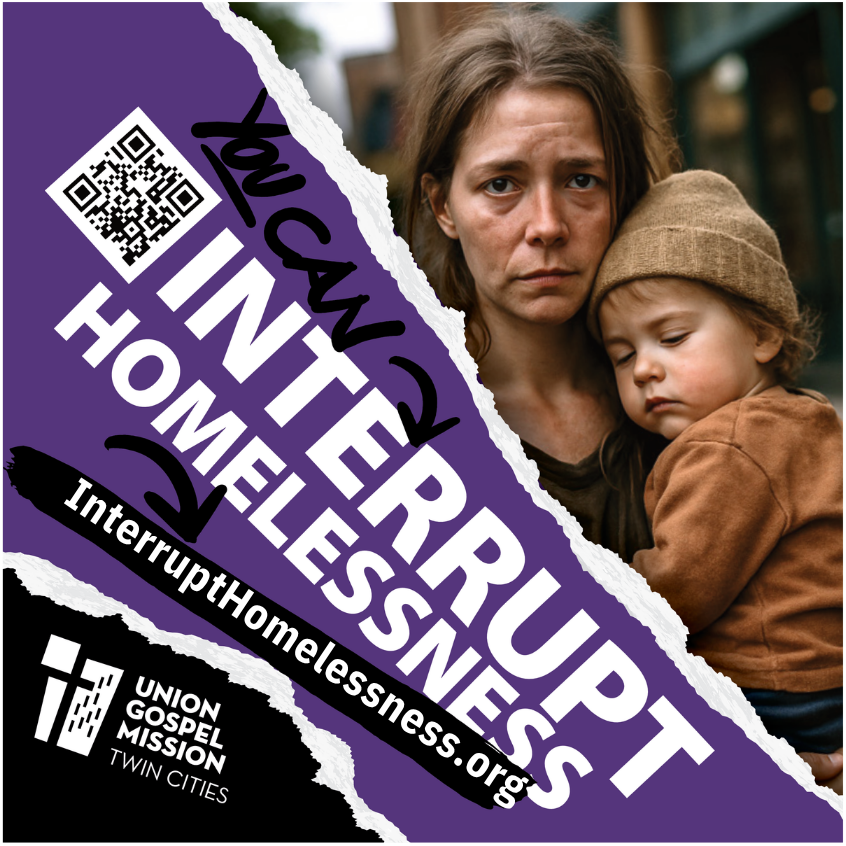
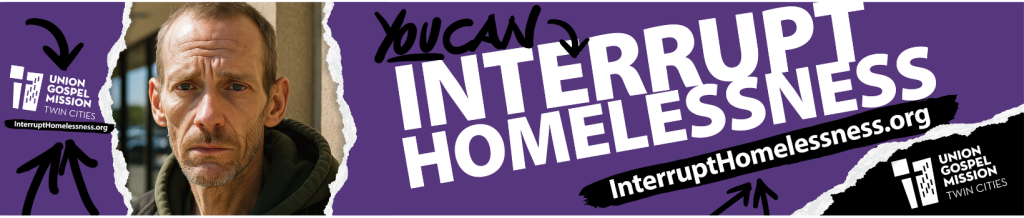
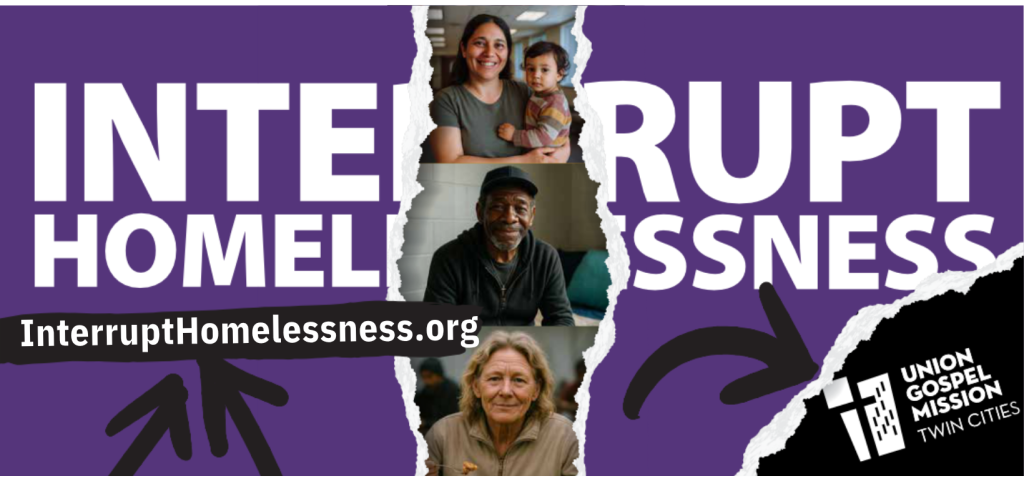
BDI recently partnered with Union Gospel Mission Twin Cities (UGMTC) on its “Interrupt Homelessness” campaign. The work began by identifying the organization’s challenges and opportunities. Our research showed that UGMTC was known in some circles, but not as widely known across the broader Twin Cities market.
Through our audience research, BDI and UGMTC were able to better understand how people in the Twin Cities were talking about homelessness. The research showed frustration, empathy, polarization and a strong interest in community action. It also revealed that the Mission was strongly associated with meals, their men’s shelter, and their Thanksgiving event. The full scope of its services was not widely understood.
The Mission had an opportunity to tell a new story about their unique services and their important role in addressing the homeless crisis throughout the Twin Cities area.
Top findings from our audience research:
1. People in the Twin Cities value community action and empathy.
The research showed that people in the Twin Cities had a strong sense of community and believed in standing together to make a difference in the homelessness crisis. This included specific callouts for volunteering, donating and showing empathy toward people in need.
2. People were frustrated by the homelessness crisis.
At the same time, the research revealed real frustration. People in the Twin Cities were more likely to talk about homelessness in connection with light rail and public transit and were also more likely to associate homelessness with drug use.
This public frustration led directly into the campaign’s need to speak into the community’s concerns and reframe their perspective on the issue.
3. People associated UGMTC with hunger and serving men.
The research also showed that many of UGMTC’s services were not widely recognized by the community. Most mentions of the organization focused on meals, hunger and serving men. In other words, the community knew part of the story, but not the whole story.
Knowing these facts gave BDI and UGMTC a stronger foundation for the campaign. We now had research showing where perceptions were inaccurate, where compassion for those in need already existed, and where we needed to create a clearer connection between UGMTC’s work and the broader homelessness crisis.
Ultimately, the campaign needed to help shift perception of UGMTC, tell the fuller story of its holistic services and show people in the Twin Cities that they could make a difference.
Build the Campaign Around a Creative Platform
A strong creative platform is essential for a brand awareness campaign. The creative platform is the central idea that holds your initiative together. It gives the campaign a point of view, a visual identity, and a message that can be repeated across channels.
For UGMTC, that platform became “Interrupt Homelessness.”
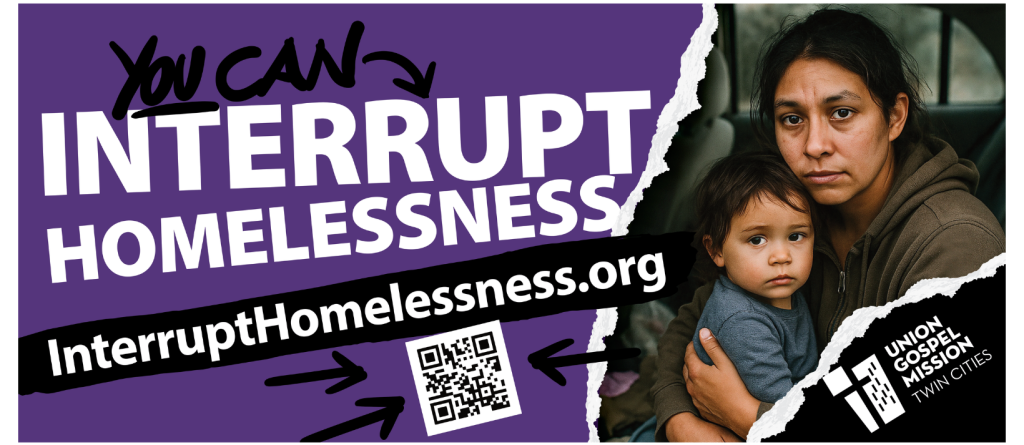
The phrase was direct. It was memorable. It acknowledged that many people see homelessness and feel overwhelmed by it while also challenging the community’s assumption that nothing can be done.
Strong creative should break through the noise, but it should not be provocative just for the sake of being provocative. It should serve the strategy, fit the organization and match the community culture.
For some organizations, the right campaign may be bold and disruptive. For others, it may need to be more hopeful, invitational or community-centered.
The point is to find the campaign idea that is true to your mission, relevant to your community and strong enough to carry across a multi-channel, integrated fundraising campaign.
Make Awareness Part of the Donor Journey
Awareness works best when it is connected to a larger donor strategy.
If someone encounters your campaign, visits your landing page and engages with your message, what happens next?
The person who sees your campaign today may not give today. But they may visit your website, watch a video, or even sign up for updates. You are creating future demand so that when the next fundraising campaign reaches them, they may be ready to respond with a gift.
It may be a pledge, a volunteer form, a giving page, or a deeper story about your programs. Strong brand awareness campaigns are part of a larger, integrated journey that can move someone from curiosity to engagement and eventually to generosity.
For UGMTC, the campaign was developed as a multi-channel, integrated journey with the following goals:
- Increased brand awareness
- Positioning UGMTC as a key player in addressing homelessness
- Engaging new audiences
- Shifting public sentiment
- Encouraging action through website traffic, lead generation, and engagement
At BDI, we think about brand awareness campaigns as one part of a larger ecosystem. The campaign should help strengthen trust, clarify the organization’s story, engage new audiences and support future fundraising. But that only happens when the campaign is intentionally connected to the donor journey.
How to Measure Awareness
If you are considering a brand awareness campaign, it’s important to understand how to effectively measure ROI.
Ultimately, this is something that should be decided by your mission team and fundraising agency at the very beginning of campaign development.
KPIs may include impressions, website traffic, new users, engaged sessions, video views, lead volume, social listening, public perception, donor conversions, attributed revenue and overall lift in organizational revenue.
In the UGMTC campaign, BDI tracked multiple forms of impact including awareness, engagement, perception, website behavior and broader fundraising health. The results showed meaningful movement across several areas:
- 23.4+ million impressions, helping UGMTC reach a broader Twin Cities audience with its “Interrupt Homelessness” message.
- 159% increase in website traffic, bringing more people to UGMTC’s digital front door during the campaign period.
- 87.9% of website traffic came from new users, demonstrating that the campaign was successfully reaching audiences beyond UGMTC’s existing base.
- 248% increase in engaged sessions, showing that visitors were not only arriving on the site, but interacting with the content.
- 92% engagement rate, reinforcing that campaign visitors were meaningfully engaging once they arrived.
- Verified increase in public perception, measured through social listening, showing the campaign was helping shift how people understood UGMTC’s role in addressing homelessness.
Practical Steps Your Organization Can Take Now
Before launching a brand awareness campaign, the first question is: Why do we want to do this in the first place?
That may sound simple, but it is the most important place to begin. Awareness campaigns require investment, alignment and a clear sense of purpose. They work best when they are tied to a meaningful organizational goal, not simply a general desire to “get our name out there.”
For example, your organization may be considering a brand awareness campaign because:
- Your community knows your name, but not the full scope of your services.
- You are preparing for a capital campaign or major expansion.
- You want to shift public perception around homelessness, poverty or addiction.
- You need to reach new audiences beyond your current donor base.
- You want to strengthen community trust before a future fundraising initiative.
- Your board or executive leadership wants to position your organization as a stronger community thought leader.
Each of these goals could lead to a different kind of campaign.
That is why the next best step is to talk with an experienced agency partner who can help you think through the opportunity clearly. Before BDI develops a brand awareness campaign, we spend time exploring your goals, your audience, your budget and your reason for pursuing the campaign in the first place.
At BDI, we develop integrated brand awareness campaigns for both current client partners and Rescue Missions that do not currently partner with BDI.
Because this work requires deep strategy, strong creative, thoughtful planning and close collaboration, BDI develops a limited number of brand awareness campaigns each year.
If your organization is wondering whether a brand awareness campaign could help your community better understand your mission, we would welcome the opportunity to explore that with you. Please contact us today to start a conversation.
Stay updated on what’s next for nonprofit fundraising!
Sign up for our newsletter today to get the fuel that will help boost your fundraising for nonprofits to the next level.