Including nine important questions you should be asking based on the data
From Michael J. Tomlinson, BDI CEO
Each year, the release of Giving USA: The Annual Report on Philanthropy gives nonprofit leaders a valuable opportunity to step back, lift their eyes, and assess the broader landscape of generosity before heading into the busy fall season.
For Rescue Missions, this year’s report offers encouragement. It also offers evidence around how donors are thinking today compared to past giving patterns.
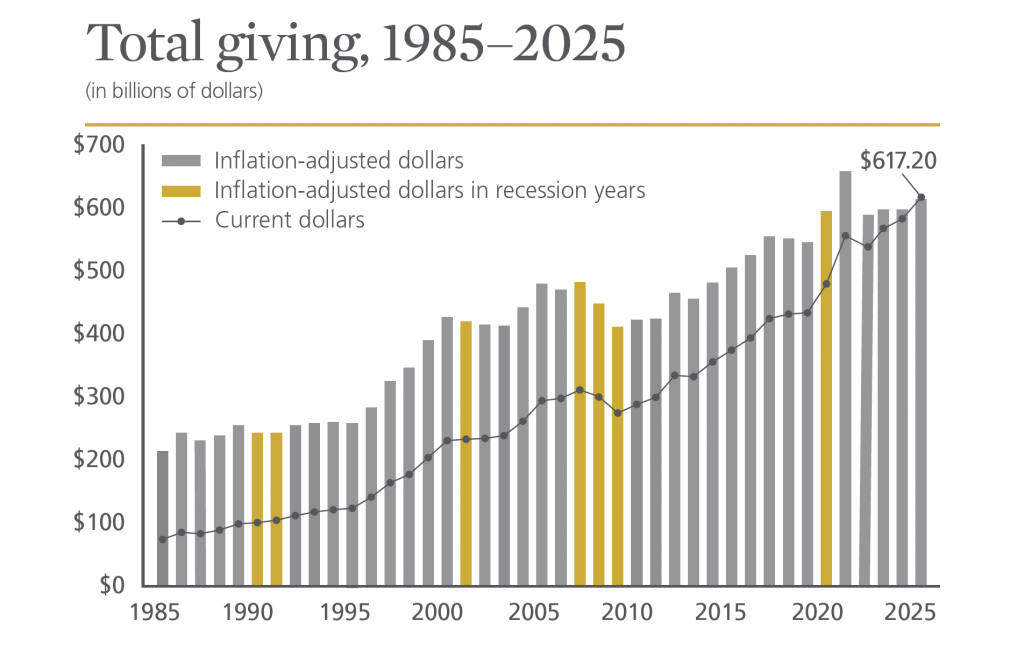
In 2025, total charitable giving in the United States reached an estimated $617.20 billion, growing 5.7% compared to 2024, which is 3.0% when adjusted for inflation. Giving by foundations and corporations reached an all-time high after being adjusted for inflation, while giving to bequests reached the second highest level of giving on record.
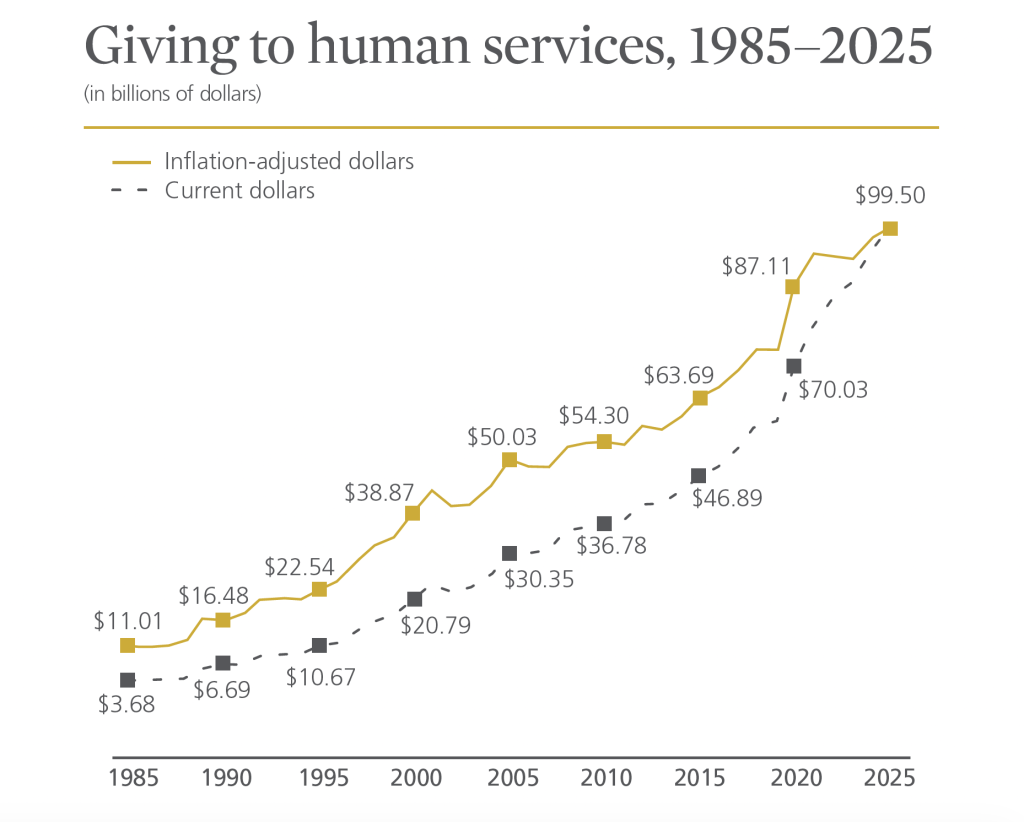
Giving to human services also grew, reaching an estimated $99.5 billion, a 5.3% increase in current dollars, and 2.6% after inflation.
That is good news for organizations like those BDI serves – organizations doing urgent, life-changing work in their communities.
Donors are still giving. People are still responding to need. Generosity remains abundant.
However, it’s vital that leaders reading this report understand the deeper message of this data, which is focused on the way generosity is changing.
For Rescue Missions, that distinction is critically important as we look ahead to the fall season and beyond. The organizations that will be best positioned for long-term health are the ones building trust, strengthening relationships, and creating clear pathways for donors to participate over time.
Today, I want to share five key takeaways from this year’s Giving USA Annual Report on Philanthropy and what they mean for Rescue Missions.
1. Long-term relationships are becoming the foundation of sustainable growth
One of the most important themes coming through this year’s Giving USA data is that successful nonprofits are focused on building long-term donor relationships and creating more flexible ways for donors to engage.
While overall giving increased by 3%, much of that growth was influenced by major and affluent donors, even as broad donor participation continues to decline.
That is a significant shift.
For many years, most nonprofits largely placed the lion’s share of their growth focus (and investments) in outreach strategies seeking new donor acquisition, sending strong messaging campaigns to replace donor attrition with more new names on the file. That had the added benefit of expanding their visibility and brand in the local community, while growing a Rescue Mission’s message ministry/program at the same time.
That model (alone) has been on the decline and is quickly becoming harder to sustain. Donor files have been progressively shrinking. Participation is declining. More revenue is being carried by fewer donors with greater capacity – and thank goodness for them and their stalwart generosity!
But when we think of support development in terms of numbers, we recognize the “math” isn’t advantageous. Then when we (rightfully) consider these numbers and names are people that we seek to connect with, serve inspirational messaging to, and provide opportunities to actualize their call to change lives alongside us – the trend becomes doubly concerning.
This does not mean that broad-based fundraising is no longer important. Direct mail, acquisition, seasonal campaigns, and emergency appeals still deeply matter to Rescue Missions and would-be supporters. They are critical – perhaps even more important than before from a ministry perspective – and remain effective onramps for generosity.
But they cannot operate as isolated efforts, nor be counted on to replace natural migration of donor’s attention (and their dollars) – especially as financial growth is required to have expanding impact. Said another way, together we can’t just be excellent with one way of telling stories and inviting participation, or outstanding at reaching just one group, however large, for support.
The data points to a new fundraising reality: organizations best positioned for long-term health are those investing in retention, middle and major donor programs, sustainer strategies, recurring giving, and personalized engagement throughout thoughtful donor pathways – alongside – increased investments in mass donor acquisition.
Every campaign needs to connect to a larger donor journey that builds trust, strengthens retention, and helps donors take their next meaningful step.
There are distinct potential advantages and opportunities for the bold Rescue Mission today who zigs when others zag; One that both engages supporters of all levels and invests to expand into a clearing field while others cut back and leave the arena seeking to only connect with bigger fish.
At BDI’s exclusive client partner Symposium this year, I shared insights around what I believe is becoming more important every day: we are not operating only in a financial economy. We are operating in a Trust Economy. People give where they trust. They commit where they trust. They stay where they trust.
And when trust declines, everything becomes more expensive, including acquisition, retention, communication, and organizational growth.
Giving USA’s report confirms what many Rescue Mission leaders are already feeling, which is that generosity is still present, but trust is harder to earn and more important to keep.
2. Donors need more than one way to say “Yes!”
The findings from this year’s report also reinforce something BDI has been seeing across the Rescue Mission landscape for several years: donors want more flexible, transparent and meaningful ways to participate.
Younger donors increasingly expect measurable impact, clear communication and authentic opportunities for community engagement. Digital and technology-enabled giving continues to grow through channels such as crowdfunding, creator-led campaigns, crypto-donations, donor-advised funds, and GivingTuesday participation.
For Rescue Missions, the key takeaway here is that donors need more than one way to say yes.
Some donors may be ready to give today through a direct response appeal. Others may be ready to give monthly, recommend a grant from a donor-advised fund, make a qualified charitable distribution, give appreciated assets, volunteer, share a campaign, or consider a legacy gift.
Your Mission’s role is to make those pathways visible, understandable, and easy to act on.
This requires a committed agency partner and an integrated strategy that connects data, donor journeys, stewardship, channel planning and major, midlevel, and mass donor development.
When those pieces work together, fundraising becomes less reactive and more relational.
And in this season, relational fundraising is not an option.
3. Human services growth is encouraging, but visibility still matters
Giving to human services grew by 2.6% in 2025, an estimated $99.5 billion in current dollars, which is an all-time high, even after adjusted for inflation.
According to the report, “the human service organizations that captured the most philanthropic support in 2025 weren’t necessarily the largest, but rather the most visible, most data-driven, and most connected to their funders before a crisis hit.”
Rescue Missions are doing some of the most urgent and transformational work in their communities. But donors and funders may not always understand the full scope of that work. If you have ever led a tour at your Mission and heard someone say, ‘I had no idea you did all this!’ you know exactly what I mean.
Your supporters may only see meals and shelter, but not the long-term work of recovery, case management, job readiness, spiritual care, housing pathways, family restoration, and life transformation.
The opportunity is for your team to invest in telling the whole story.
This means using data to show impact. It means showing how need is changing in the community. It means telling your unique mission with clarity and sharing meaningful stories of transformation that help donors understand what their dollars are doing and why their generosity matters.
In the Trust Economy, visibility is not vanity. It is stewardship and it’s the first step to a trusting relationship
Today’s donors want to know that their gift worked. They want to see that the promise made in the appeal became real in the life of another person. When Missions communicate with honesty, specificity and follow-through, they build the kind of trust that turns a gift into a relationship.
4. Faith-based Rescue Missions have a unique opportunity
Many Rescue Missions also sit within the broader faith-based giving landscape, and Giving USA’s religion data offers both caution and opportunity.
For years, religion has dominated the charitable landscape, but today religion now represents only 23% of overall giving. This decline is largely due to the secularization of America, resulting in reduced interest and therefore reduced funding in faith-based organizations.
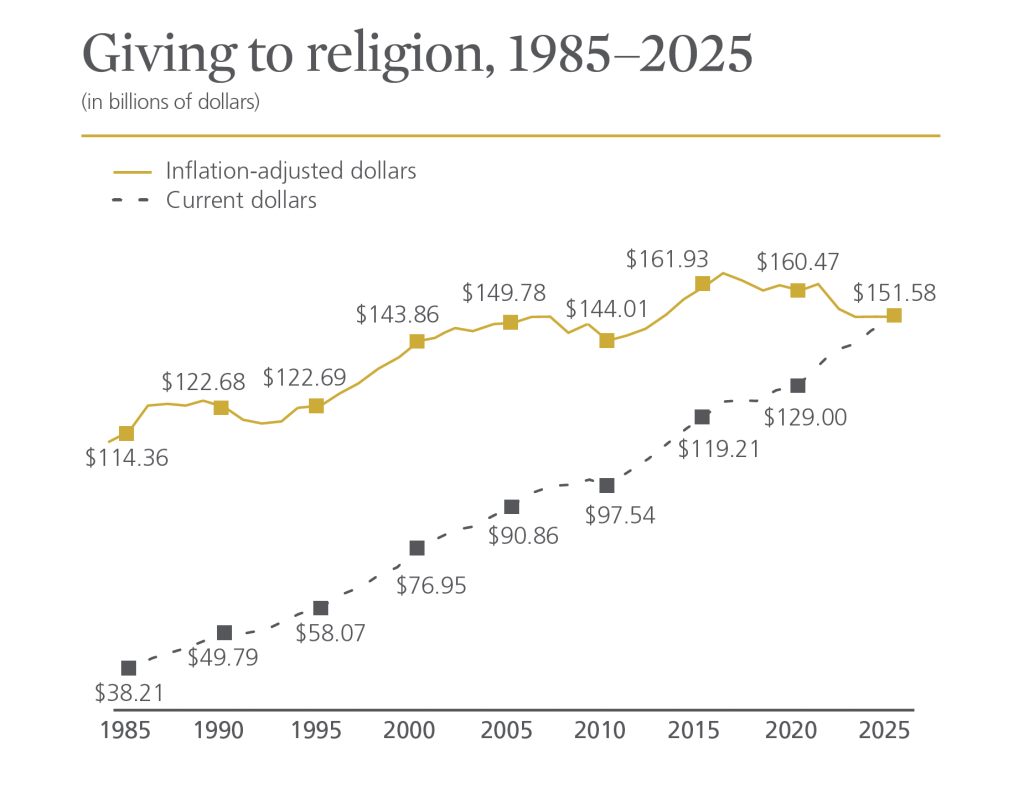
This points to ongoing shifts tied to reduced interest in faith-based organizations and lower worship attendance.
At the same time, there’s a strong opportunity to engage religiously affiliated donors, as they continue to be the most affluent in the country. This includes engagement through retention and uplevel strategies such as planned giving, middle and major donor communications, and donor-advised funds.
Today’s donors need to understand both the spiritual heart and the practical outcomes of the work. They need to see faith expressed through service, compassion made visible, and generosity connected to real transformation.
It is essential that Rescue Missions craft their communications in a way that helps supporters see the full truth of the work from serving a warm meal, to lives being restored. The strongest Mission fundraising will not separate faith, need and impact. It will bring them together in a way that feels clear, personalized, sincere, and with the unique donor in mind.
5. The Great Wealth Transfer should move planned giving from “someday” to today – from hoping and waiting to strategies.
The findings from this year’s report points to several areas Rescue Missions should take seriously, including donor-advised funds, bequests, QCDs, planned giving, foundation relationships and midlevel donor engagement – which is especially important as we look toward the Great Wealth Transfer.
And as mature folks have worked longer, are living longer, and have watched their assets compound in value – but largely held off the distribution phase of resource distribution, we’ve been waiting for years while seeking evidence that the GWT has begun. We thought we’d seen this begin to happen in 2024, and that’s been confirmed in 2025. It’s game on folks!
It is estimated that $125 trillion will be passed down from older generations to the next generation of givers over the next 20 years or so, between now and 2045.
As wealth continues to move from older generations to the next, Rescue Missions have a significant opportunity…but only if they are building these relationships now.
Giving by bequest totaled $62.19 billion in 2025, growing by 19.7% from 2024 (a growth of 16.6% percent when adjusted for inflation).
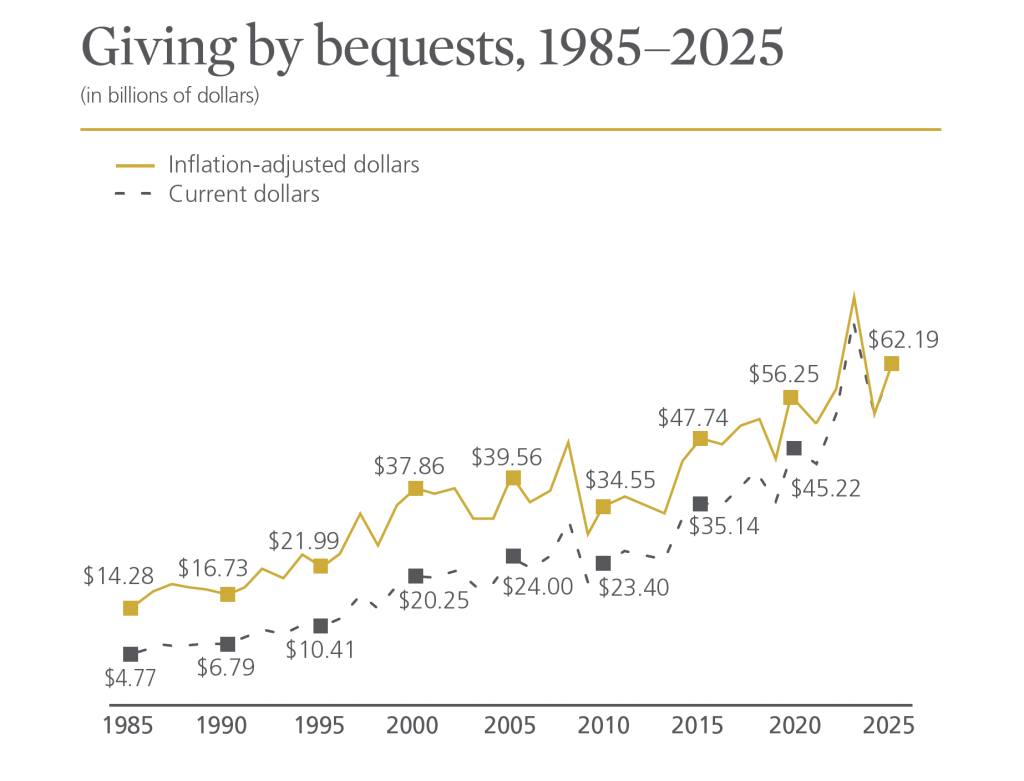
Giving USA’s bequest commentary reinforces the importance of making planned giving information easy to find, promoting bequests through multiple channels, educating donors about beneficiary designations, and preparing staff to discuss QCDs with clarity and confidence.
DAFs also continue to grow in popularity and influence. In fact, according to the report, “donor-advised funds are among the fastest growing forms of giving.”
Nonprofits need to move beyond treating DAF gifts as administrative transactions and develop intentional, integrated strategies to identify, engage and steward DAF donors, including midlevel donors who may be increasing their philanthropic capacity through DAFs.
For Rescue Missions, these opportunities should not sit apart from the annual fundraising plan. They should be woven into the donor experience.
A supporter who gives faithfully over many years may also be a strong planned giving prospect. A midlevel donor may have DAF capacity. A retiree donor may be ready to consider a QCD. A foundation relationship may need to be cultivated long before the next community crisis creates urgent need.
This is where a strategic, integrated fundraising strategy becomes essential.
Fundraising can no longer be a one-size-fits-all approach. The goal is to understand donors well enough to offer the right next step at the right time.
What Rescue Mission leaders should be asking now
The future of fundraising will not be built by more campaigns alone. It will be built by stronger donor relationships, clearer pathways for engagement, and a more integrated strategy for growing generosity over time.
Here are some questions that I encourage you to ask your team to ensure that your organization is adapting alongside these changing times:
- Are we retaining donors, or mostly replacing them?
- Are we helping first-time supporters take a meaningful next step?
- Are we making impact visible enough for investors to trust and stay engaged?
- Are we identifying potential midlevel donors early enough?
- Are we inviting people into recurring giving with clarity and purpose?
- Are increasingly popular support channels like DAFs, QCDs, shared gifts of stock, and planned giving easy to understand across our donor touchpoints?
- Are our direct mail, digital, text, email, major donor, and stewardship strategies all working together and voiced with one clear vision?
- Are we preparing now to help harvest the tremendous opportunities ahead with The Great Wealth Transfer by building trust with donors whose legacy decisions may shape the future of our work?
- Are we building trust and relationships before moments of crisis, or waiting until urgent need forces the conversation?
The Opportunity Ahead
The message of Giving USA 2026 is not that generosity is fading.
It is that generosity is changing shape – and that historic new opportunities lie ahead!
Your supporters still deeply care. They still reliably respond to need. They still feel called to help people in crisis. They still want to be part of work that brings hope and healing to their communities. And they still want to live out their faith with compassion, action, and generosity by coming alongside the poor, the helpless, and the hopeless.
AND… they also require more clarity, more flexibility, more visible impact, and more meaningful engagement. And more than anything, they are looking for trust.
For Rescue Missions, this is a moment of tremendous opportunity. Even in the midst of unprecedented and unfamiliar change all around us, we should be energized and inspired!
The need is real. The generosity is present. The work ahead is to build stronger pathways between the two.
At BDI, we believe fundraising is not simply about securing the next gift. It is about helping donors see their role in the mission and inviting them into deeper partnership over time through personalized, integrated fundraising strategy.
If you have any questions about this report or interest in learning about BDI, please contact us today. We would love to chat with you.
Stay updated on what’s next for nonprofit fundraising!
Sign up for our newsletter today to get the fuel that will help boost your fundraising for nonprofits to the next level.