
Use our Fundraising Benchmark tool to see where you stand!
Fundraising Benchmark Tool
Enter your organization's data to see how you compare to industry benchmarks.
Benchmarks based on rescue mission industry data. Your results are not stored or shared.
Fundraising is shifting… fast.
Fewer donors. Higher expectations. More pressure on every dollar.
The question is: are you adapting or falling behind?
Our 2026 Missions Benchmark Report shows exactly what’s changing… which donors you should focus on… and what it all means for your Mission.
BDI’s President Mike Rogers breaks it down for you in this video. Watch now!
BDI’s Missions Benchmark Report is the result of a comprehensive study with data from 35 Rescue Missions. It reveals what works… and where there is opportunity for growth.

The traditional donor pyramid has a foundation of many donors giving small gifts, with fewer donors giving larger gifts. However, that pyramid has flattened and evolved.
In this new trapezoid, fewer donors carry more financial responsibility.
Welcome to the new shape of fundraising.
What’s changing the shape of generosity...

Click to see how your metrics compare to BDI Rescue Missions.
Donor value is up, while active donors are down.
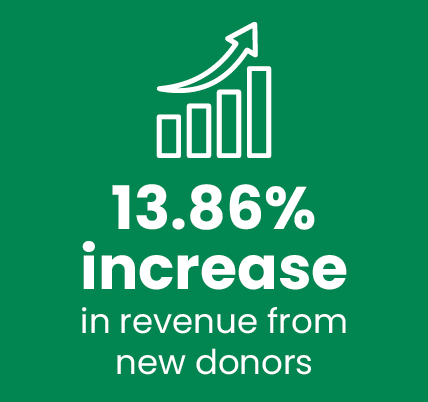
BDI’s in-house donor acquisition strategy is proving to be incredibly strong for our Rescue Mission partners, who saw a 13.86% increase in revenue from new donors. While offline channels contributed to this increase with strong growth, online remains the largest acquisition channel – accounting for 56% of new donors.
Additionally, the average gift size increased 3.97%, and revenue per donor rose 2.76% – even as the number of active donors declined slightly (–0.45%). This aligns with the wider trend we’re seeing: fewer donors are giving overall, but those who remain engaged are giving at higher levels. As a result, a smaller number of donors account for a larger share of total revenue.
Key takeaway: Mass donor participation is declining, while larger gifts are becoming more influential.
Growth Opportunity:
Build acquisition momentum.
Digital channels continue to generate the majority of new donors, so it’s critical to build and maintain a strong online acquisition program. At the same time, your acquisition strategy and donor lifecycle strategy must work together.
Take time to understand how new donors enter your database and how their giving behavior changes over time. By actively monitoring how your donor base evolves, you’ll be better positioned to change strategies, strengthen donor relationships and sustain long-term growth.
Revenue is increasing, but donors are not.
The total number of active donors remained largely flat for BDI partners, declining slightly by –0.45%. Yet despite this, total revenue increased by 2.3%, and revenue per donor increased by 2.76%. These trends align with the triangle to trapezoid shift we’re seeing, with more revenue coming from a smaller group of donors.
The average 3-year lifetime value of online donors also increased by 7.15%, reinforcing the strong long-term value of digital acquisition. We also saw a 9.92% increase in online revenue for one-time gifts.
Although the average value of new online gifts declined by 5.9%, this suggests digital channels are bringing in donors who start with smaller gifts and increase their giving over time.
Key takeaway: The era of growing revenue simply by expanding the donor file is fading.

Growth Opportunity:
Invest in the donor lifecycle.
While acquisition remains important, focus on deeper engagement with the donors already in your file. This means placing greater strategic emphasis on the donor lifecycle – including second-gift conversion, sustainer growth, mid-level development, major donor cultivation and thoughtful reactivation strategies.
While other agencies have reported similar patterns of revenue growth and declining donor participation, BDI client partners see strong results in both donor retention and long-term donor value growth.
Retention is strong among BDI partners.
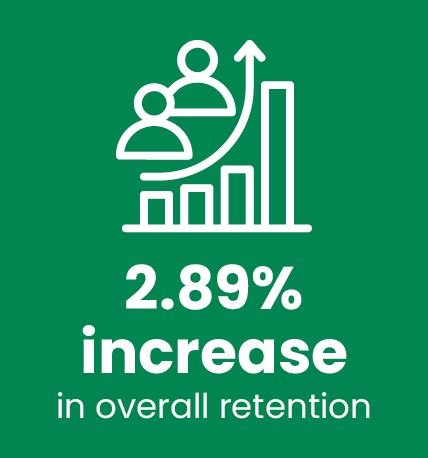
BDI Rescue Mission partners are successfully retaining and growing their donor base – particularly in online channels where retention is typically more difficult. Overall retention increased from 61.39% to 63.16%.
It is important to note, however, that retention among mid-level donors declined 0.97%, while major donor retention declined 1.95%.* As mid-level and major donors represent a substantial share of total revenue, minor changes in retention within these segments can have an outsized impact on overall fundraising performance.
Key takeaway: Even modest retention gains can have a significant impact on long-term revenue stability – especially as returning donors typically give more and upgrade at higher rates over time.
*Mid-level: Single largest gift over $1,000 or cumulative giving between $2,500–$9,999
Major: $10,000+
Growth Opportunity:
Be intentional about cultivation.
Retention is the foundation for nearly every other area of growth. When your donors remain engaged over time, you are better positioned to develop second gifts, sustainers, mid-level donors and major donor relationships.
Develop intentional cultivation strategies that prioritize consistent communication, meaningful engagement and clear pathways for donors to deepen their relationship with your organization.
Sustainer acquisition is the opportunity.
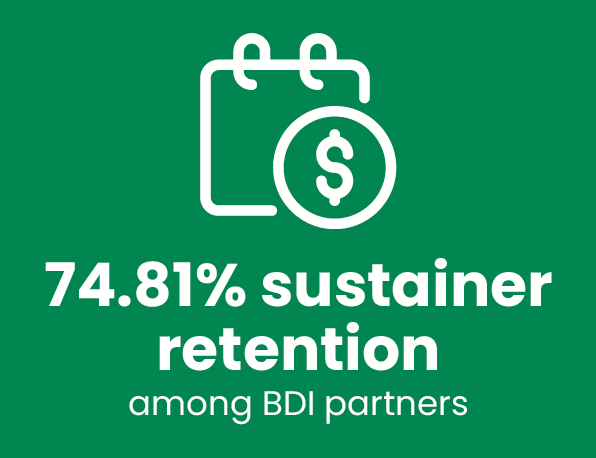
69% of BDI partners increased sustainer retention year over year. These are donors who give automatic recurring gifts. As a whole, sustainer retention increased by 3.52%, while sustainer revenue declined by 3.14%.
These numbers suggest that while existing recurring donors remain highly committed, their overall contribution levels may be flat or declining slightly. Sustainer acquisition also remained relatively flat. This highlights the importance of moving donors through the donor lifecycle. Rescue Missions should focus efforts on both acquiring new monthly donors and upgrading single-gift donors who show capacity for recurring giving.
Key takeaway: Rescue Missions may not be fully capturing the momentum of monthly giving.
Expand sustainer acquisition.
Reactivation is a Key Acquisition Strategy
Recurring donors are significantly more valuable over time. On average, a monthly donor is worth 4.6× the lifetime value of a one-time donor, and many continue to make additional gifts beyond their recurring commitment.
It’s no surprise that monthly giving programs are growing by approximately 5% year over year across the sector. They now represent nearly one-third of all online revenue for many organizations.
Make sustainer acquisition as a year-round strategy. Integrate it into your paid social campaigns, email upgrade series, new donor onboarding journeys and key fundraising moments such as Giving Tuesday and year-end.
Want to learn more? Check out these 5 fundraising strategies to focus on in 2026.
Acquisition and reactivation are driving growth.
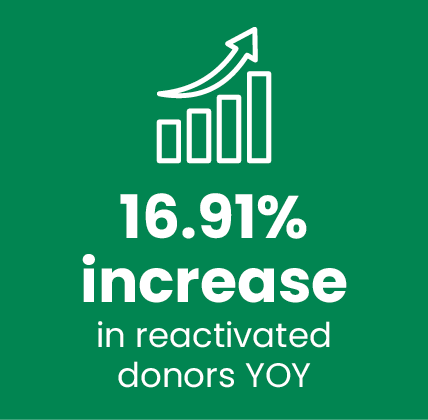
BDI Rescue Missions saw strong momentum in donor acquisition and reactivation. New donors increased 13.86% year over year, while reactivated donors grew by 16.91%.
These gains are especially important in the current fundraising environment. As donor participation declines, it is increasingly important to both bring in new donors and successfully re-engage past ones.
Despite these improvements, the total number of active donors still declined slightly by 0.45%. However, the gap is narrowing. Rescue Missions are doing a good job of stabilizing their donor file even in a challenging fundraising environment.
Key takeaway: Lapsed donors who haven’t given recently remain highly responsive to reactivation efforts, so it’s important to invest in a strong win-back program.
Growth Opportunity:
Invest in a strong win-back program.
Reactivated donors are one of your most efficient growth opportunities. These supporters already know your organization, have previously demonstrated generosity and often return at a lower cost than acquiring entirely new donors.
Develop a structured win-back program with dedicated messaging, consistency and a coordinated channels strategy. It may be one of the highest-ROI investments you can make to strengthen your donor file.
Want to learn more? Read this article for 4 tips to optimize your direct mail acquisition program.
Direct mail and digital... better together.
BDI Rescue Mission partners saw a 13.91% increase in unique donors online. While online giving continues to grow, offline fundraising remains an important part of a strong integrated fundraising strategy.
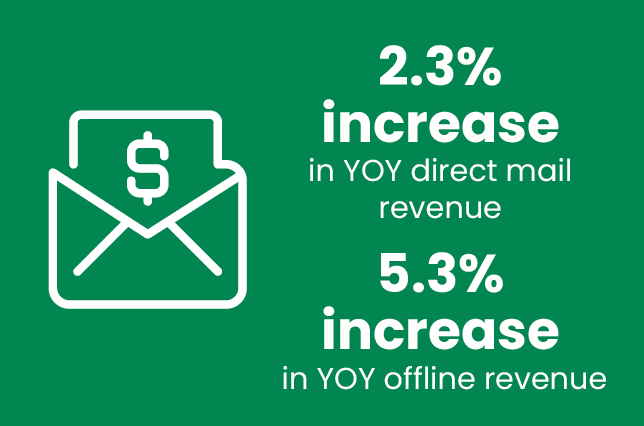
Revenue from new offline donors increased by 13.86%. Direct mail revenue also grew 2.3% year over year. This indicates that traditional outreach is still effective, especially when integrated into a coordinated, multi-channel strategy.
Key takeaway: Missions that align direct mail with email, digital ads and online outreach will see stronger response rates and deeper donor engagement.
Growth Opportunity:
Build an integrated fundraising ecosystem.
BDI partners continue to demonstrate that coordinated multi-channel strategies outperform siloed programs. When offline and digital channels work together, they can strengthen response rates, increase donor engagement and capture more of the generosity already present in your community.
Use digital channels to amplify the impact of your direct mail program. This includes digital co-targeting, email and SMS outreach, and geo-fencing campaigns that reinforce mailed appeals.
Connect
There’s a reason so many Rescue Missions trust BDI. Ready to see what that could look like for you? Let’s talk.

Carter Wade
Chief Growth Officer
As the fundraising landscape changes, Rescue Missions have two options: adapt to the latest giving trends... or risk falling behind.
Find out how you measure up to other Rescue Missions... and discover how you can protect, grow and sustain your organization into the future.
These insights and more are available NOW in BDI's 2026 Missions Benchmark Report.
